Close Quarter Maneuvering: Protecting Your Fleet from Costly Stationary Object Collisions
As safety managers of commercial vehicle fleets, you know that every collision impacts your bottom line through vehicle damage, increased insurance premiums, downtime, and potential liability. Yet one of the most preventable types of incidents continues to plague fleets across the nation: collisions with stationary objects during close quarter maneuvering.
The Hidden Danger of Backing and Tight Maneuvering
While most drivers spend less than 1% of their driving time in reverse, about one-quarter of all collisions occur while backing. For fleet drivers, these statistics are even more alarming—backing incidents account for up to half of all on-the-job vehicle collisions.
In Texas alone, over 10,000 drivers cited backing as a factor in vehicle crashes in 2019, resulting in serious injuries and fatalities.
Why Stationary Objects Are a Major Threat:
Stationary objects—poles, trees, loading docks, buildings, parked vehicles, and equipment—pose unique challenges during close quarter maneuvering:
- Limited visibility: Large vehicles and trailers create significant blind spots
- Depth perception issues: Mirrors and cameras can distort distance judgment
- Counter-intuitive movements: Trailers pivot opposite to the vehicle
- Tight spaces: Loading docks, customer sites, and parking lots offer little room for error
- Changing environments: Obstacles can appear after a driver's last visit to a location
The Financial Impact on Your Fleet
Every collision with a stationary object costs your organization:
- Vehicle repair and downtime
- Increased insurance premiums
- Workers' compensation claims
- Lost productivity
- Damage to customer property and relationships
- Legal liability
These incidents are entirely preventable with proper training and procedures.
Essential Practices to Prevent Stationary Object Collisions
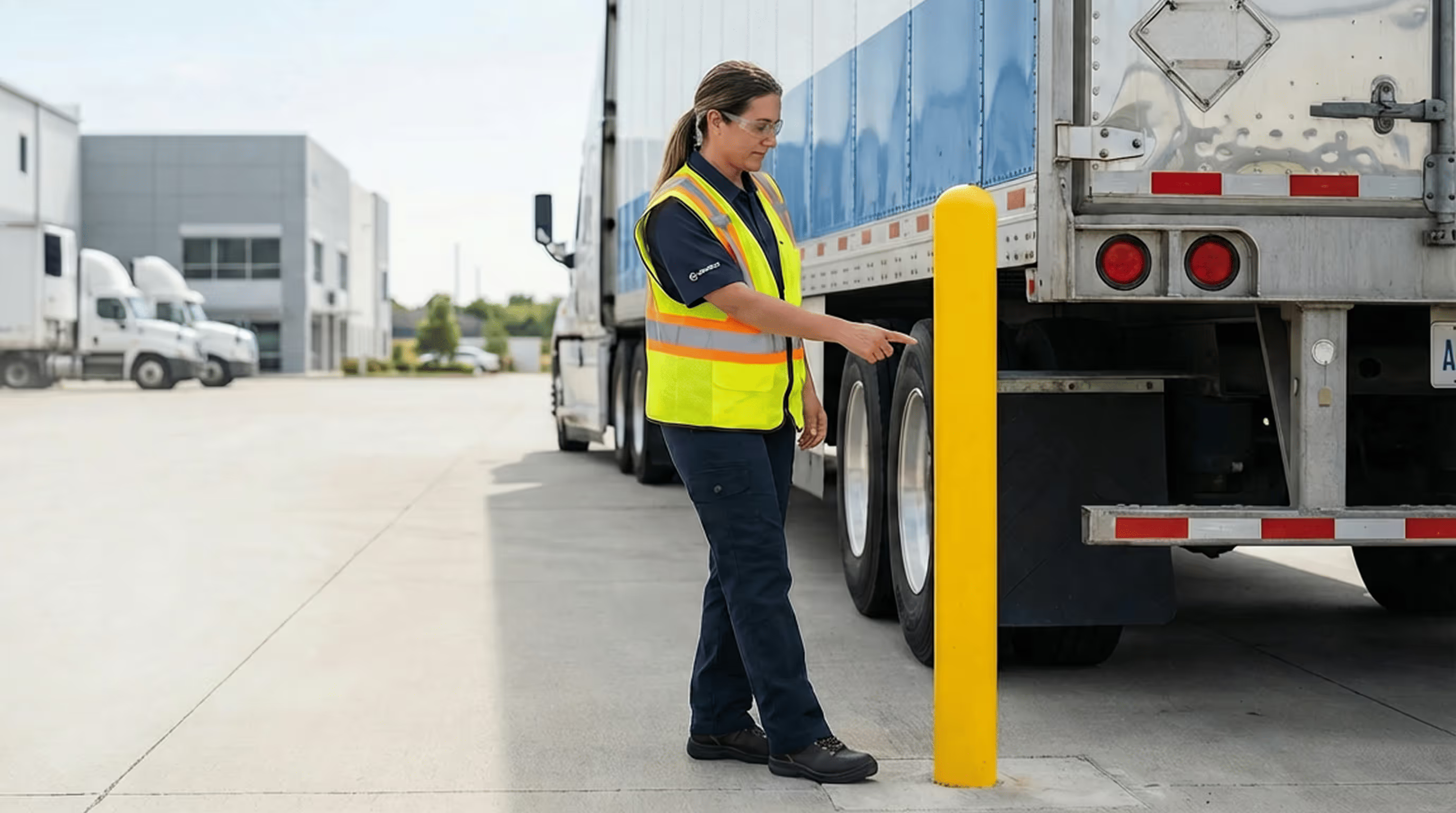
1. G.O.A.L. - Get Out And Look!
This is the golden rule for professional truck drivers and should be mandatory for all fleet operators. G.O.A.L. is especially important given the wider blind spots on trucks and road equipment.
Walk-around checklist:
- Look for poles, trees, buildings, or other obstacles
- Check for low-hanging electrical wires or tree branches
- Identify debris, pallets, nails, screws, and bolts
- Verify that trailer doors are closed
- Note soft ground, potholes, or tire hazards
- Take action immediately—return and start backing within seconds so the environment doesn't change
2. Clear Movable Obstacles
If a forklift or any other moveable obstacle is too close to a driver’s approach path, they should ask to have it moved. It doesn't matter if other drivers navigate around it—the driver's safety is paramount.
3. Know Your Vehicle's Clearances
Before maneuvering, drivers must identify:
- Overhead clearances (wires, canopies, tree branches)
- Side clearances (bollards, posts, building corners)
- Rear clearances (loading docks, other vehicles)
4. Use Technology, But Don't Depend on It Alone
Technology tips:
- Adjust all mirrors before maneuvering
- Use cameras as an additional view, not the only view
- Remember that mirrors and cameras affect depth perception
5. Plan to Avoid Backing Altogether
The safest backing maneuver is the one drivers don't have to make. Encourage your drivers to:
- Choose pull-through spaces
- Park defensively
6. Use a Trained Spotter
When available, spotters can be invaluable—but only if used correctly:
- Choose spotters who understand how the vehicle functions
- Establish hand signals before beginning
- Keep the spotter visible in the driver's side mirror
- Roll down the window to hear verbal instructions
- Stop immediately if the spotter moves out of sight
Spotters should be familiar with what the driver experiences in the driver's seat, ideally another trucker or equipment operator.
7. Master the Fundamentals of Backing
For all vehicles:
- Back slowly—use idle speed when possible
- Cover the brake with your foot
- Turn off music and silence phones
- Turn on hazard lights and tap the horn before backing
- Keep backing distance to a minimum
For vehicles with trailers:
- Remember: the trailer goes opposite to where you turn the wheel
- Use the steering wheel as a visual guide: top = vehicle, bottom = trailer
- Watch the tires and axles, not just the trailer back
- Use painted lines or landmarks to gauge direction
- Don't hesitate to start over—multiple attempts are better than a collision
8. Never Assume
Never assume people will stop or not walk behind a backing vehicle. If someone appears in the mirror, stop until they're in a safe position.
9. It's Okay to Say "No"
Empower your drivers to refuse unsafe situations. If an environment poses too many risks and hazards cannot be reduced, drivers should not enter dangerous backing areas. This protects your people, vehicles, and company.
Creating a Culture of Safety
To reduce stationary object collisions in your fleet:
- Implement comprehensive training: Make backing safety and close quarter maneuvering a core component of driver training
- Practice regularly: Set up cone courses for drivers to practice backing in controlled environments
- Establish clear policies: Create written procedures for high-risk maneuvering situations
- Use telematics: Monitor backing incidents and provide coaching
- Reward safe behavior: Recognize drivers who follow proper procedures
- Investigate all incidents: Learn from every collision to prevent the next one
- Maintain vehicles: Ensure cameras, sensors, and mirrors are clean and functional
The Bottom Line
Most backing collisions with stationary objects are caused by poor technique—not equipment failure or unavoidable circumstances. With proper training, clear procedures, and a commitment to safety, these incidents are entirely preventable.
Every collision avoided protects your drivers, preserves your equipment, maintains customer relationships, and strengthens your company's bottom line. The few extra seconds it takes to get out and look, plan a safe approach, or start over when a maneuver isn't going right are a small investment compared to the cost of a collision.
Your action items:
- Review your current backing and maneuvering policies
- Schedule refresher training for all drivers
- Emphasize G.O.A.L. as a non-negotiable practice
- Empower drivers to prioritize safety over speed
- Consider upgrading older vehicles with safety technology
Remember: the goal isn't just to avoid collisions—it's to create a culture where every driver returns home safely at the end of every shift, and every vehicle stays on the road earning revenue for your company.
For more information on developing comprehensive driving safety programs for your fleet, or to discuss other safety initiatives contact a Nirvana Safety Manager today. We're here to help you protect your drivers, vehicles, and business.
Sources:
- Texas Department of Insurance, Division of Workers' Compensation - Vehicle Backing Safety Fact Sheet (2020)
- National Safety Council - Defensive Driving Modules
- Insurance Institute for Highway Safety - Crash Prevention Research








.avif)