.png)
If you've ever stared at your Compliance, Safety, Accountability (CSA) percentile after a roadside inspection or a crash and wondered whether it's an accurate reflection of your fleet's safety culture — you're not alone. Most fleet owners have never had someone sit down with them and explain what that number actually tells FMCSA, what it doesn't tell them, and what you can do when you believe the data behind it is wrong.
Let's fix that.
What the CSA Score Is — and Isn't
The Federal Motor Carrier Safety Administration (FMCSA) uses the CSA program to identify carriers that may pose a safety risk. Your scores are organized across seven Behavior Analysis and Safety Improvement Categories, known as BASICs. Each BASIC measures a different risk category:
- Unsafe Driving
- Hours of Service (HOS) Compliance
- Driver Fitness
- Controlled Substances/Alcohol
- Vehicle Maintenance
- Hazardous Materials Compliance
- Crash Indicator
Your percentile ranking within each BASIC tells FMCSA how your carrier compares to peer carriers — those with similar size and operational profiles. A high percentile (closer to 100) flags your fleet for potential intervention. A low percentile (closer to 0) suggests you're performing better than your peers.
Here's the critical nuance most fleet owners miss: a percentile ranking is not the same as a risk score.
You could have a 75th percentile in Unsafe Driving and still be operating a legitimately safe fleet — if you've simply had more roadside inspections than average, or if peer carriers in your segment have unusually low violation rates. Percentile rankings are relative, not absolute. Context matters enormously.
The Unsafe Driving BASIC: A Closer Look
The Unsafe Driving BASIC is one of the most visible — and most misunderstood — components of CSA scoring. It captures violations observed during roadside inspections, including:
- Speeding
- Reckless driving
- Improper lane changes
- Inattentive driving
- Failure to use a seatbelt
These violations are weighted by severity and recency. More recent violations carry heavier weight than older ones, and more serious violations score higher than minor infractions. A single speeding violation from 18 months ago will carry less weight than one from last month.
A high Unsafe Driving BASIC percentile is a signal worth taking seriously — but it should also trigger an honest review of your inspection history, not a panic. Are the underlying violations accurate? Were they properly documented? Do they reflect your drivers' actual behavior, or do they reflect a data error?
When the Data Is Wrong: DataQ and Preventability Determinations
Here's something every fleet safety manager should know: CSA data is not infallible, and you have tools to challenge it.
The DataQ Program
FMCSA's DataQ system (available at dataqs.fmcsa.dot.gov) allows carriers and drivers to formally challenge the accuracy of inspection and crash data used in CSA scoring. If you believe a violation was improperly cited, incorrectly recorded, or the result of a documentation error, DataQ is your avenue for requesting a review and correction.
Common grounds for a DataQ challenge include:
- The violation was cited to the wrong carrier or driver
- The inspection report contains factual errors
- The violation code was incorrect
- The underlying standard was misapplied by the inspector
Successful DataQ challenges can result in violations being corrected or removed from your record entirely — which directly improves your BASIC percentile.
Preventability Determinations
For crashes recorded in the Crash Indicator BASIC, FMCSA offers a separate process: the Crash Preventability Determination Program (CPDP). This program allows carriers to request that FMCSA review a crash and make a formal determination about whether the crash was or was not preventable.
A non-preventable determination doesn't remove the crash from your record, but it does add a notation visible to enforcement personnel and safety investigators — context that can make a meaningful difference in how your carrier is perceived and how enforcement attention is directed.
Crashes most commonly reviewed under this program include:
- Crashes where your driver was struck by a wrong-way or impaired driver
- Crashes caused by sudden medical emergencies involving another driver
- Crashes involving vehicles that ran a stop sign or red light
If you've had a crash that wasn't your driver's fault, filing for a preventability determination is worth the effort.
What You Should Be Doing Right Now
Whether your BASIC scores are clean or you've got some work to do, here's a practical checklist for staying ahead of your CSA data:
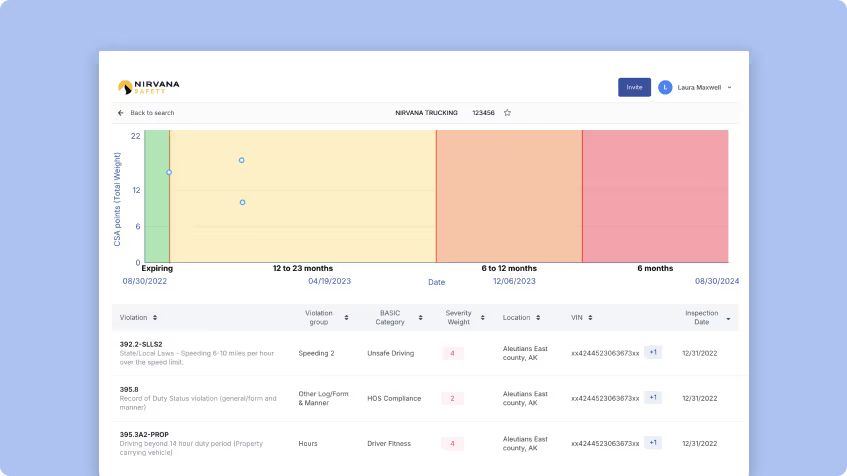
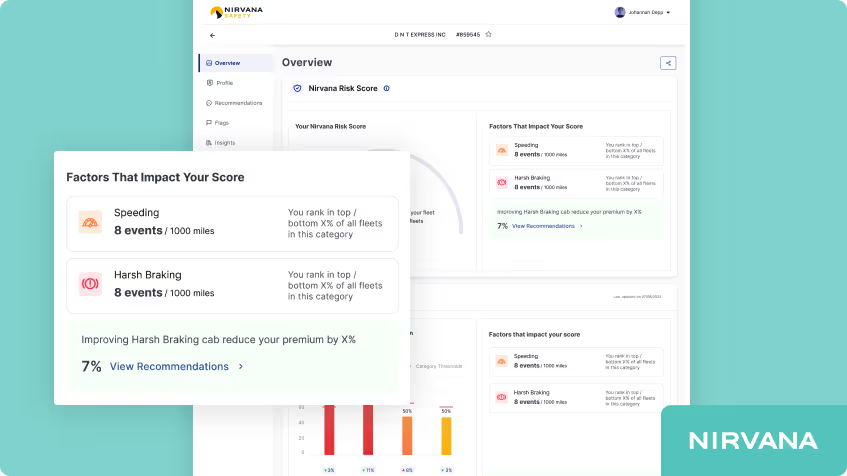
- Review your SMS profile monthly. Log into FMCSA's Safety Measurement System (SMS) or the Nirvana Safety App and review your BASIC scores and underlying violations on a regular basis. Don't wait for an intervention notice.
- Audit your inspection history. For every roadside inspection resulting in a violation, verify that the data recorded matches your driver and vehicle records. Catch discrepancies early.
- File DataQ challenges promptly. You have two years from the date of the inspection to challenge an entry, but acting sooner is better. Documentation is fresher and easier to gather.
- Track crash records separately. Keep a running log of all DOT-recordable crashes, along with your internal analysis of contributing factors. This supports preventability filings and strengthens your legal defensibility if litigation follows.
- Train your drivers on what CSA measures. When drivers understand that roadside inspection outcomes affect the company's BASIC scores — and that those scores affect insurance, operating authority, and load opportunities — they're more likely to treat each inspection seriously.
The Bottom Line
Your CSA score is a tool, not a verdict. It's a snapshot of your inspection and crash history relative to your peer group, weighted for recency and severity. It is not a comprehensive judgment of your fleet's safety culture — and it can contain errors that you have every right to challenge.
At Nirvana, we work alongside fleet safety managers every day who are navigating exactly this kind of complexity. Understanding your CSA data — and knowing when and how to push back on it — is part of running a defensible, well-managed fleet.
Have a question about CSA scoring or want to talk through what your current BASIC scores might mean for your fleet? Reach out to our team. We're here to help you make sense of it.


















.avif)